

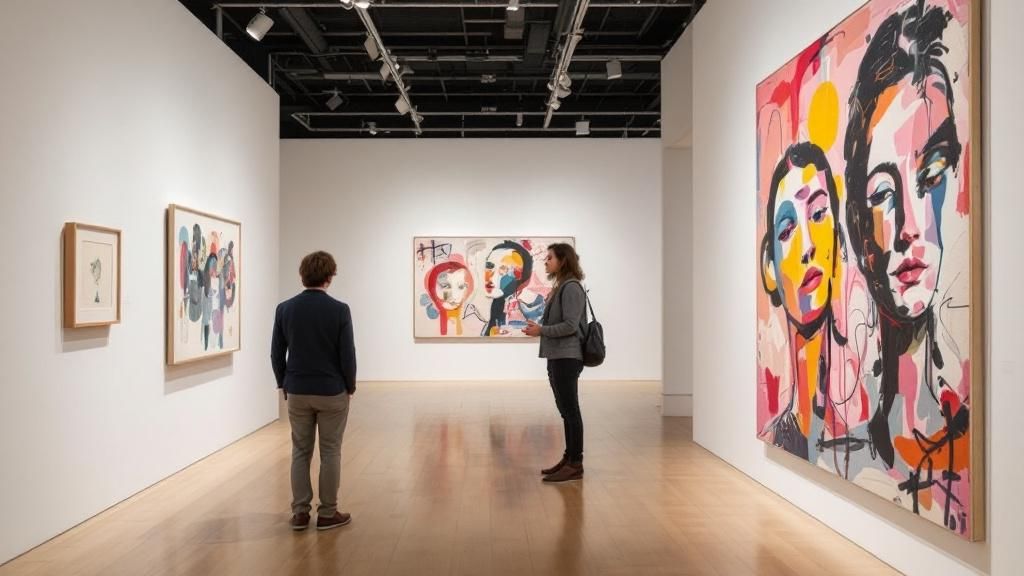
The Turner Prize has operated as a barometer for contemporary artistic innovation, and this year’s exhibition proves no exception. By showcasing works that deliberately blur the lines dividing abstraction and representation, the curators have crafted a thought-provoking challenge to viewers’ preconceptions about what art can communicate. This article investigates how the featured practitioners deploy experimental methods and intellectual models to challenge our understanding of artistic vocabulary, ultimately questioning whether the traditional distinctions between abstract and representational art hold relevance in today’s creative landscape.
Redefining Conceptual Limits
The Turner Prize exhibition this year deliberately dismantles conventional categorisations that have traditionally influenced artistic discourse. By showcasing pieces that fluidly move between abstraction and figuration, the curators prompt viewers to reassess their preconceptions about visual meaning-making. The exhibition shows that today’s artists increasingly reject binary classifications, instead embracing hybrid approaches that interrogate how we perceive and interpret visual information. This curatorial approach prompts visitors to reflect more carefully with the artist’s intention and aesthetic experience.
These boundary-pushing works demonstrate a wider movement within current art practice towards conceptual flexibility and experiential ambiguity. Rather than adhering to rigid categorical boundaries, the featured artists utilise techniques that intentionally undermine spectator preconceptions. The presentation shows that abstraction and representation are not wholly distinct territories but rather positions on a coherent range. This reconceptualisation prompts profound reflection about the way meaning develops through the dialogue among artwork, viewer perception, and interpretive context, profoundly altering artistic discourse.
The Progression of Graphic Expression
Visual language has undergone significant change across the twentieth and twenty-first centuries, notably as artists grappled with photography’s threat to representational painting. Modernist movements originally positioned abstraction as a radical break from mimetic traditions, creating seemingly insurmountable conceptual divides. However, present-day creators are coming to see these historical demarcations as imposed limitations. The exhibition shows how visual language evolves organically, drawing in diverse influences and methodologies that transcend traditional categorical boundaries, mirroring our increasingly complex visual culture.
Contemporary artists now combine elements from abstraction, representation, and conceptual frameworks with unprecedented sophistication. This integrative approach recognises that visual communication operates through multivalent channels simultaneously. The Turner Prize exhibition showcases how artists employ colour, form, composition, and symbolic reference to produce layered meanings that resist singular interpretation. This evolution demonstrates that creative vocabulary has matured beyond dogmatic constraints, embracing instead a sophisticated lexicon capable of expressing the complexities inherent in contemporary experience and perception.
Modern Readings
Contemporary artists approach abstraction with markedly distinct conceptual approaches than their past practitioners, drawing from postmodern theory, digital contexts, and worldwide artistic practices. Rather than pursuing abstraction in its purest form as an conceptual destination, present-day creators treat abstract forms as communicative tools within broader conceptual strategies. The exhibition features artworks where geometric forms, mark-making, and colour relationships coexist with figurative imagery and text-based components. This pluralistic approach reveals current perspectives that visual significance develops through multifaceted exchanges rather than through individual aesthetic allegiances or stylistic dogmas.
The selected artists demonstrate remarkable facility in engaging with multiple visual registers at once, creating works that repay careful consideration and interpretive flexibility. Their practice suggests that modern artistic practice increasingly functions as a dialogue between artist, artwork, and viewer, rather than as a one-way pronouncement. By incorporating diverse visual languages, these artists recognise that the creation of meaning in modern cultural contexts requires sophisticated navigation of competing aesthetic systems. The exhibition finally suggests that modern critical understanding requires viewers relinquish fixed categorical approaches, embracing instead the generative uncertainty that defines sophisticated artistic practice.
Public Response and Community Dialogue
The exhibition has generated substantial conversation amongst art critics and academics, with reactions spanning from strong approval to cautious doubt. Conservative voices have queried whether the fusion of abstract and representational forms constitutes genuine innovation or merely visual ambiguity. Alternatively, forward-thinking commentators have commended the exhibition organisers for challenging rigid classifications that no more represent current artistic approaches. This spectrum of perspectives highlights the exhibition’s significance as a catalyst for meaningful discourse within the art world and beyond.
Public involvement in the exhibition has surpassed projections, reaching broad demographic segments beyond the traditional museum-visiting audience. Social media commentary indicates that visitors are actively grappling with the works’ conceptual underpinnings, sharing interpretations and challenging different viewpoints. Museums have reported increased footfall and longer engagement periods, demonstrating that patrons are genuinely invested in grasping artistic purpose. This community-driven interest shows that contemporary art can resonate powerfully with the broader community when offered adequate contextual framework and conceptual clarity.
The exhibition’s influence reaches further than direct critical assessment, potentially affecting future curatorial practices and artistic direction across institutional settings. Emerging artists have identified the exhibition as a watershed moment, affirming experimental methods that merge the abstract and the representational. Learning institutions are beginning including the exhibition’s ideas into curricula, recognising its educational significance. As dialogue evolves to evolve, the Turner Prize exhibition appears poised to take a prominent role within contemporary art history, reframing discussions about artistic categorisation and artistic possibility.
